 In this Painting WAR issue, the renowned painter Alberto Mateos Jurado, from Avahn Art Studio, shares different techniques focused on the creation of bases for wargames. The issue presents building and painting techniques that can be used on different themed bases, such as sci-fi, fantasy and historical. Each base is sorted by levels of difficulty, which helps the reader to identify its complexity before starting the painting process. Furthermore, some techniques to create bases in a fast and easy way can also be found, allowing the modeler to achieve outstanding results in a short time.
- Introducing the first book of the Fifteen Knots editorial line, which includes Vallejo’s publications related to ship modeling. The author Ramir Durá, renowned naval modeler, shares with you the processes and techniques used to recreate the main actors of the famous naval battle of World War II at Scapa Flow. Through the construction of a German submarine in 1/350 scale and a British battleship in 1/700 scale, the author describes the historical events that took place at the British naval base at Scapa Flow in 1939. In this book, you will discover expert assembly and painting techniques, as well as the use of photo etched accessories to add detail to both vessels. In addition, you will learn tips and techniques for building bases that reproduce the surface of the sea, along with the use of specific materials for this purpose.
- “Armour of the Eastern Front 1941-1945” is the first in the new series by Guideline License Publications and the team that brings you Military Modelcraft International in collaboration with Acrylicos Vallejo. The publication examines some of the AFVs that shaped the war on the Eastern Front during World War II – or the “Great Patriotic War” as it is remembered in Russia – which was a titanic conflict and the greatest clash of arms in history. The subjects have been chosen with the modeler in mind and each article provides both reference and inspiration using authoritative text, archival and walkaround photos as well was specially commissioned colour profiles.
- The publication examines some of the twin-engined medium bombers of World War Two and includes a selection of profiles by Richard Mason, as well as a ground-breaking piece of research on the early B-25 Mitchell by Brian Derbyshire that offers an incisive look into the business of wartime mass-production and the vast number of changes to the ensuing airframes brought about as a result of ongoing combat experience. Other aircraft covered include the rarely discussed Tupolev SB-2, the Mitsubishi G4M Betty, Bristol Blenheim, Savoia-Marchetti SM.79, Petylyakov Pe-2 and the Handley Page Hampden.
- License Publications and the team that brings you Military Modelcraft International in collaboration with Acrylicos Vallejo. The end of the Cold War and the collapse of the Soviet Union in 1991 should have signaled a lasting ‘peace dividend’ for the countries of NATO. Instead, within a decade, the ‘War on Terror’ had refocused military spending away from conventional arms and the armor-heavy formations of the Cold War era. However, as the level of NATO’s commitment to the wars in Afghanistan and Iraq reduced, Russian aggression in the Crimea and Ukraine led to a renewed emphasis on peer-on-peer warfare and a revival of more traditional forms of armored firepower. This book, looks in detail at the armored fighting vehicles employed by NATO armies, their allies and partners, from the end of the Cold War to today. From the mighty Leopard 2 Main Battle Tank to the ex-Warsaw Pact vehicles now employed by NATO’s Eastern European allies and partners. Each article provides a unique historical perspective, well-illustrated by carefully selected photos, and with individual vehicles illustrated in color profiles. On top of this superb reference material, a modelling gallery displays some of the most inspirational NATO armor models from the pages of Military Modelcraft International
- The first volume in the Landscapes of War series contains many examples, both in terms of modeling and painting, allowing the reader to create a variety of different environments and natural elements, including paths, beaches, rocks, trees, snow and water.
- This publication shows the modeller an approach to the painting and aging processes on all types of vehicles in a state of wear, abandonment and destruction, as interpreted by the modellers Scratchmod Rob, Mike Rinaldi, Virgil Suarez, John Tolcher, Adam Wilder and Chema Cabrero. The book Includes step by step instructions by each author, with a foreword by Mike Rinaldi.
- Civilian trucks and other civilian equipment have a much longer lifetime than military equipment, and are therefore much more subject to the influence of the natural effects of dust, dirt, and of course rust. In this book Eugene Tur shows the complete step by step weathering of 7 vehicles.
- This first book of the The Armoured Side collection offers a presentation of the different color schemes used by the IDF from the very beginning up to the present. Renowned modellers will take us though painting and weathering processes on deployed armored vehicle kits such as Sherman, Centurion, the M60 and the Merkavas.
- Two top professionals of Sci-fi hobby painting offer their most original views in the first Quasar collection book, which offers creativity without boundaries and content that no lover of Sci Fi can miss: robots, spaceships and post-apocalyptic vehicles!
- In this book Javier Redondo shows, through a series of thorough step-by-step guides, how to paint and weather a simple US Olive Drab camouflage or the more unusual tritonal camouflage patterns used by the US Army. Through a variety of armoured and softskin vehicles, all subject to very different weather conditions, the book shows a great variety of both painting and weathering techniques. To showcase the author’s work, the book outlines different techniques and provides information about the colors and the techniques used in an accessible and visual format. In addition, at the end of each article there is a color chart which helps to clearly identify the colors and products used. At the end of the book there is a section of profiles to provide even more options when painting US Army vehicles and a gallery of other pieces made by the author. The book is a complete and fascinating guide, not only for lovers of the US Army vehicles in World War II, but also for any modeler who wants to learn how to reproduce painting and weathering effects with acrylics.
- In this book Javier Redondo shows, through a series of thorough step-by-step guides, how to paint and weather a simple US Olive Drab camouflage or the more unusual tritonal camouflage patterns used by the US Army. Through a variety of armoured and softskin vehicles, all subject to very different weather conditions, the book shows a great variety of both painting and weathering techniques. To showcase the author’s work, the book outlines different techniques and provides information about the colors and the techniques used in an accessible and visual format. In addition, at the end of each article there is a color chart which helps to clearly identify the colors and products used. At the end of the book there is a section of profiles to provide even more options when painting US Army vehicles and a gallery of other pieces made by the author. The book is a complete and fascinating guide, not only for lovers of the US Army vehicles in World War II, but also for any modeler who wants to learn how to reproduce painting and weathering effects with acrylics.
- Without a doubt, aircraft such as the Corsair, Hellcat and Avenger were icons of the US Navy during World War II. This book from the bench of accomplished modeler Jordi Lario shows how this type of aircraft can be painted exclusively with Vallejo products. From the painting of the cockpit and interior to the final stages of weathering, the techniques and tricks necessary to achieve excellent results are shown through a multitude of step-by-step guides, highlighted sections and visual information. Through the different aircraft featured, the reader can understand how to paint everything from monochrome finishes to interesting tritonal camouflage, thus covering the main schemes used from 1944 to 1945. The book is a complete and interesting guide, not only for lovers of US Navy aircraft from World War II, but also for any modeler who wishes to learn how to paint cockpits, interiors, camouflage and weathering effects exclusively with acrylics to individualize each model.
- The fourth volume in the Landscapes of War series focuses on the creation of dioramas in industrial environments through a wide set of step-by-step processes. It shows the construction and painting of the main elements that can be found in any industrial environment: concrete, metal doors, silos, corrugated roofs, metal structures, pipes, drums and other accessories.
- The first volume of the Diorama Project series illustrates the main techniques for both the assembly and painting of military vehicles that are to be placed in a diorama, paying special attention to those details that will help to integrate the vehicle into the scene in a realistic way.
- This third volume addresses the construction and painting of bases for dioramas, including both natural and urban environments. Through three detailed step-by-step articles, we delve into how to build and paint muddy terrain, riverbanks, and urban environments, as well as the proper techniques for integrating vehicles and figures with the terrain.
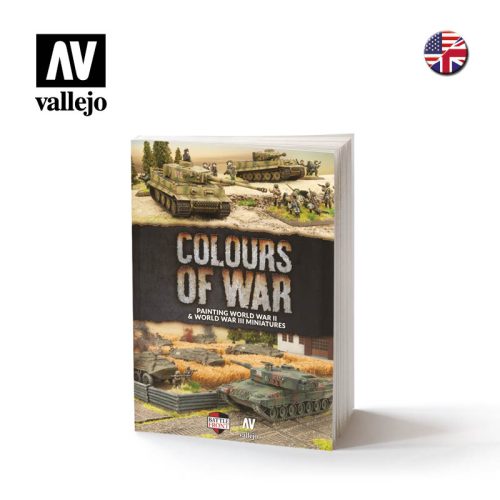
A comprehensive system for painting WWII & WWIII miniatures. What this book aims to do is distil the combined knowledge and ideas of the Battlefront studio into a concise and coherent collection of painting tips and guides. This book will teach you tried and tested processes, which balance ease and efficiency with positive results, and will give you the know – how and confidence to paint any Flames of War & WWIII miniatures.
Number of pages: 140
Format: A4
Language: English- The third instalment in the Landscapes of War series is focused on making dioramas set in rural landscapes. It shows how to build, paint and weather the principal architectural features that can be found in different European locations.