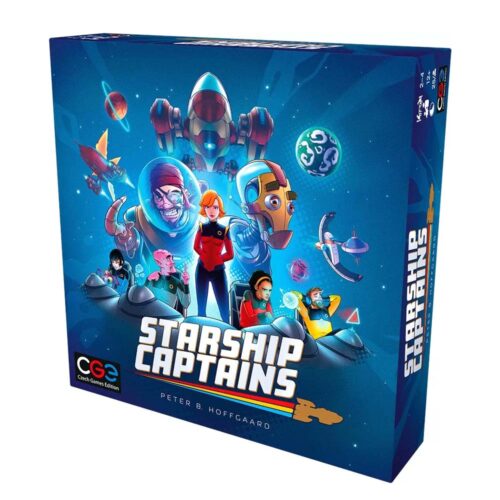
 Hailing all Starship Captains! Get ready to embark on a maiden voyage through the cosmos in this euro-style action selection and engine building game for 2-4 players. • Manage a diverse crew of cadets, ensigns, androids, and officers—each with different special roles and capabilities. • Earn medals to promote and train your crew for even greater effectiveness. • Explore an ever-shifting galaxy full of dangerous pirates and interplanetary missions. • Upgrade your ship with powerful engine building technology for maximum synergy. • Boost your reputation with three distinct galactic factions for bountiful rewards. Explore a galaxy full of dangerous pirates and interplanetary missions, as you manage, train, and promote your crew to improve their diverse skills. Then harness the power of cool alien technology to help your crew tackle goofy missions through the stars and beyond. Author: Peter B. Hoffgaard Players: 1-4 Age: 12+ Time: 25 mins / player Theme: Train your crew, upgrade your starship, and take on daring missions as a new starship captain in an ever-shifting galactic adventure.
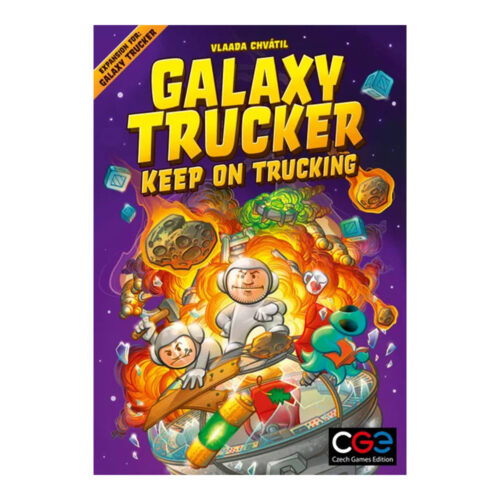 Do you laugh at pirates, shrug off combat zones, and meet every meteor with cannons blazing? If you've mastered the basics of Galaxy Trucker, then you're ready for this expansion! Corp Inc has new ships they would like you to try. Ships that will challenge you. Ships that will make you ask, "What were they thinking?!" Your ships will be thoroughly tested by new adventures. And if your flights still seem easy, Rough Roads cards can turn a humdrum milk run into a twisted spatiotemporal nightmare. To meet these challenges, you'll have access to new components offering new tactical options. And you'll be able to fly with new aliens who each have a unique ability. The different parts of the expansion can be mixed and matched, allowing you to choose the combination that will be most fun for you. So whether you're flying with grizzled veterans who miss the thrill of exploding space ships, or teaching newbies who just survived their first flight, this expansion will help you Keep on Trucking! Author: Vlaada Chvatil Players: 2-4 Age: 8+ Time: 30 min Theme: Build a space ship and fly it across the Galaxy. Deliver goods for a profit ... if the pirates and meteors don't blast your ship apart. Mechanics: Players simultaneously build space ships out of tiles, which they grab as fast as they can.
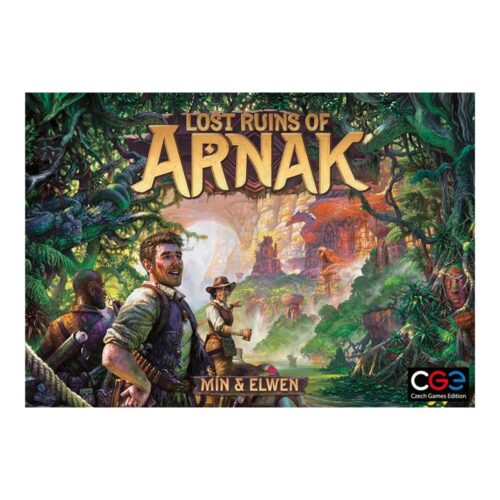 Authors: M?n & Elwen Year: Q4 2020 Players: 1?4 Age: 12+ Time: 30 min/player Theme: Players lead rival expeditions to a newly discovered island. Explore jungles, find artifacts, and discover the Lost Ruins of Arnak! Mechanics: A unique combination of worker placement and deckbuilding
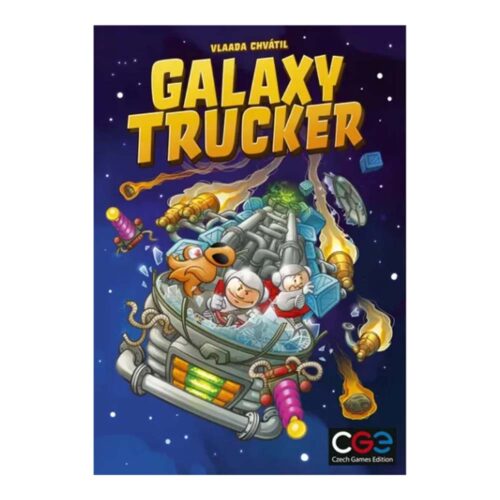 Once the ships are launched, players encounter dangerous situations while vying for financial opportunities, each hoping to gain the most valuable cargo and finish with as much of their ship still intact as possible. Of course, that's easier said than done since many hazards will send pieces of your ship, your cargo, and your crew hurling into the depths of space. The goal is to survive the trek — hopefully with at least some of your crew and ship intact — and have at least one credit by the end of the game. (Profit, yay!) Players earn credits by delivering goods, defeating pirates, having the best-looking ship, and reaching their destination before the others. This version of ''Galaxy Trucker'' is a relaunch of the original 2007 release by Vlaada Chvátil that features new art, more ship tiles, tweaked card effects, and streamlined gameplay that consists of only a single flight through space. That said, should you want a longer, more challenging experience, you can play a three-flight campaign known as the "Transgalactic Trek". Author: Vlaada Chvátil Year: Summer 2021 Players: 2-4 Age: 8+ Time: 30 min Theme: Build a space ship and fly it across the Galaxy. Deliver goods for a profit ... if the pirates and meteors don't blast your ship apart. Mechanics: Players simultaneously build space ships out of tiles, which they grab as fast as they can.
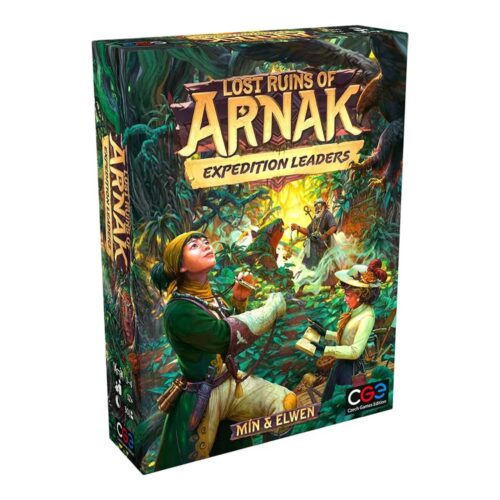 Authors: M?n & Elwen Year: 2021 Players: 1?4 Age: 12+ Time: 30 min/player Theme: Players lead rival expeditions to a newly discovered island. Explore jungles, find artifacts, and discover the Lost Ruins of Arnak! Mechanics: A unique combination of worker placement and deckbuilding
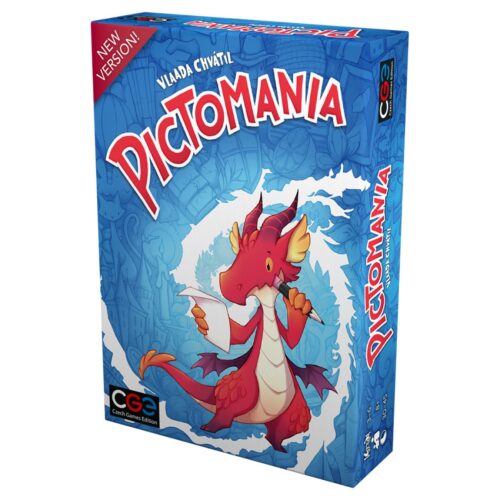 Is she drawing an elk or a moose? Is he drawing a pegasus or a unicorn? These are the types of questions you will probably be asking yourself during a game of Pictomania! There's no time to draw a complex masterpiece in Pictomania, the drawing game in which everybody draws and everybody guesses ? all at the same time! Players sketch the essence of the word with a few quick lines and try to guess the others' drawings while there's still time. This second edition of Pictomania features revised word cards with a brand new look. One big change for this edition compared to the base game is that only three word cards are in play no matter the player count, allowing you to jump into each round more quickly since you don't have to read as many words to guess who might be drawing what.
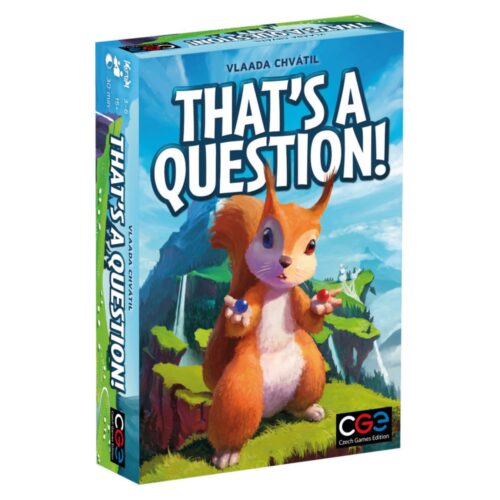 The party game That's a Question!, takes the familiar format of challenging others with questions, then voting on what they'll say. In more detail, each player has a hand of hexagonal cards, with words or phrases in three color blocks on the card. On a turn, you choose a player that has a token in front of them, take that token, then present them with a question by choosing one of the three question prompts (which are all color-coded), then choosing two cards from your hand and adding the properly-colored section of those cards to the question. A sample question: "What would you miss more if it ceases to exist: Facebook or doors?" That player secretly votes on A or B, while everyone else but the questioner secretly votes A or B depending on how they think the person will answer; a voter can optionally add their 3x scoring token to their vote. Once everyone votes, you reveal the tiles. Everyone who voted correctly moves ahead one or three spaces on the scoring track, and the questioner moves ahead one space for each person who voted incorrectly. If you pass a certain space on the scoring track, you retrieve your 3x token (if you've used it). Since you can ask a question only of those with a token in front of them, everyone is asked roughly the same number of questions, and whoever has the most points after a certain number of rounds wins.
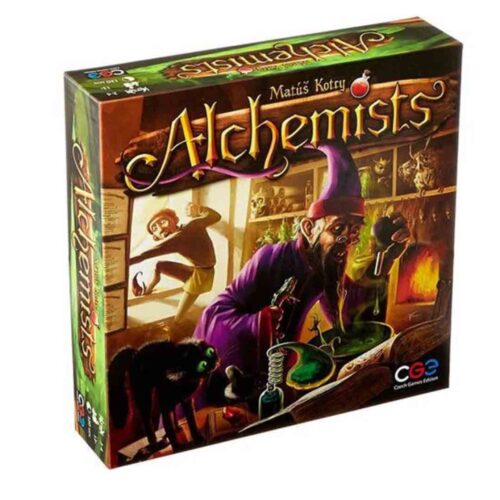 In Alchemists, two to four budding alchemists compete to discover the secrets of their mystical art. Points can be earned in various ways, but most points are earned by publishing theories ? correct theories, that is ? and therein lies the problem. The game is played in six rounds. At the beginning of the round, players choose their play order. Those who choose to play later get more rewards. Players declare all their actions by placing cubes on the various action spaces, then each action space is evaluated in order. Players gain knowledge by mixing ingredients and testing the results using a smartphone app (iOS, Android, and also Windows) that randomizes the rules of alchemy for each new game. And if the alchemists are longing for something even more special, they can always buy magical artifacts to get an extra push. There are 9 of them (different for each game) and they are not only very powerful, but also very expensive. But money means nothing, when there's academic pride at stake! And the possession of these artifacts will definitely earn you some reputation too. Players can also earn money by selling potions of questionable quality to adventurers, but money is just a means to an end. The alchemists don't want riches, after all. They want respect, and respect usually comes from publishing theories. During play, players' reputations will go up and down. After six rounds and a final exhibition, reputation will be converted into points. Points will also be scored for artifacts and grants. Then the secrets of alchemy are revealed and players score points or lose points based on whether their theories were correct. Whoever has the most points at the end of the game wins.
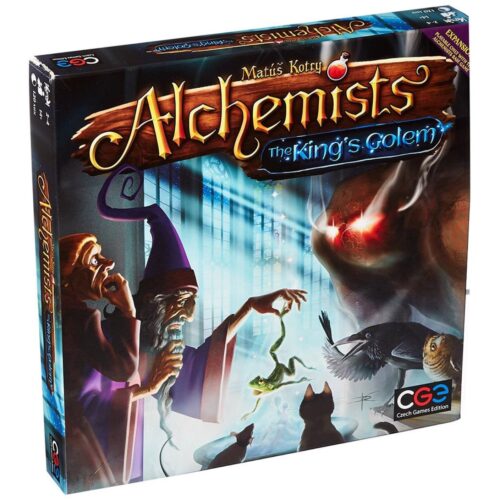 Alchemists: The King's Golem, an expansion to Alchemists, brings you a new logic puzzle with new rewards and consequences. Can you figure out how to animate a golem? And equally important, can you convince the king you are making progress? The expansions are presented in order of complexity. Startup Funding and Busy Days will be just fine for beginners. The Royal Encyclopedia is for players accustomed to the logic puzzle of the base game. The Golem Project is for advanced players who want a new deduction challenge.
 Codenames is an easy party game to solve puzzles. The game is divided into red and blue, each side has a team leader, the team leader's goal is to lead their team to the final victory. At the beginning of the game, there will be 25 cards on the table with different words. Each card has a corresponding position, representing different colors. Only the team leader can see the color of the card. The team leader should prompt according to the words, let his team members find out the cards of their corresponding colors, and find out all the cards of their own colors to win.
 Codenames Duet keeps the basic elements of Codenames Give one-word clues to try to get someone to identify your agents among those on the table! But now you're working together as a team to find all of your agents. (Why you don't already know who your agents are is a question that Congressional investigators will get on your back about later!) To set up play, lay out 25 word cards in a 5x5 grid. Place a key card in the holder so that each player sees one side of the card. Each player sees a 5x5 grid on the card, with nine of the squares colored green (representing your agents) and three squares colored black (representing assassins). Three of the nine squares on each side are also green on the other side, one assassin is black on both sides, one is green on the other side and the other is an innocent bystander on the other side. Collectively, you need to reveal all fifteen agents - without revealing an assassin - before time runs out in order to win the game. Either player can decide to give the first one-word clue to the other player, along with a number. Whoever receives the clue places a finger on a card to identify that agent. If correct, they can attempt to identify another one. If they identify a bystander, then their guessing time ends. If they identify an assassin, you both lose! Unlike regular Codenames, they can keep guessing as long as they keep identifying an agent each time; this is useful for going back to previous clues and finding ones they missed earlier. After the first clue is given, players alternate giving clues.
 What are these strange symbols on the map? They are code for locations where spies must contact secret agents! Two rival spymasters know the agent in each location. They deliver coded messages telling their field operatives where to go for clandestine meetings. Operatives must be clever. A decoding mistake could lead to an unpleasant encounter with an enemy agent - or worse, with the assassin! Both teams race to contact all their agents, but only one team can win. Codenames: Pictures differs from the original Codenames in that the agents are no longer represented by a single word, but by an image that contains multiple elements.
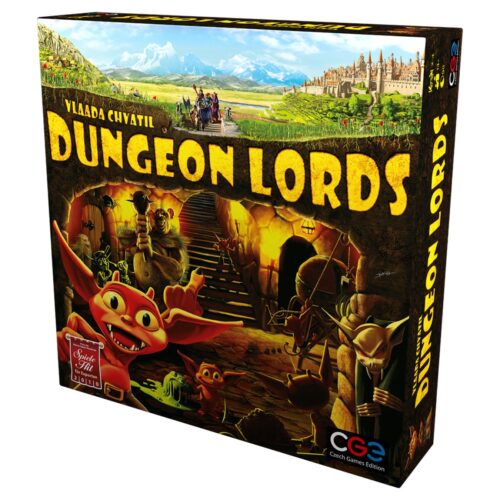 In Dungeon Lords, you are an evil dungeonlord who is trying to build the best dungeon out there. You hire monsters, build rooms, buy traps and defeat the do-gooders who wish to bring you down. Have you ever ventured with party of heroes to conquer dungeons, gain pride, experiences and of course rich treasure? And has it ever occurred to you how hard it actually is to build and manage such underground complex filled with corridors and creatures? No? Well now you can try. Put yourself in role of the master of underground, summon your servants, dig complex of tunnels and rooms, set traps, hire creatures and try to stop filthy heroes from conquering and plundering your precious creation. We can guarantee you will look on dark corners, lairs and their inhabitant from completely different perspective! Each turn, players use a hand of cards to choose where to place their worker. Actions vary from mining gold, hiring monsters, buying traps etc. Each action has three spots available - with each spot having different effects (e.g. mining gold lets you mine more gold in each spot). When using the cards, two cards will become locked and will not be able to be used next turn. There are 4 turns to place actions for each game "year" and two game years in a whole game. Each turn is identified as a "season". Each season, players will get to see the heroes and events to come in the following season. Thus allowing them to prepare. At the end of each season (after the first), heroes will be allocated to each player according to their level of evil. Heroes range from mighty heroes to sneaky thieves. Each hero has their own power for which the player needs to prepare for. Finally, at the end of each year, the heroes will travel down into the dungeon to fight. Scoring in the game is based upon what you have built, the monsters you have hired and the heroes you have captured.
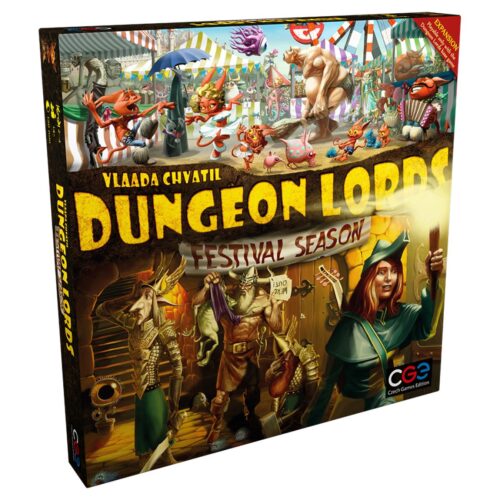 Dungeon Lords: Festival Season is a big expansion that includes lots of Dungeon Lording goodness. The game is still played over two years, but now each year has five rounds instead of four: winter, spring, summer, autumn and festival season. More time to build your dungeon, but also more time for adventurers to gather a larger party. There are new monsters, rooms, and traps to prepare your dungeon for the battle, but also new nasty spells for the adventurers and sneaky bards who encourage them to perform so-called "heroic" deeds ? not to mention two paladins for each year, now ready to punish up to two evil players. Would you like to push other players toward evil instead of moving yourself toward good when visiting the city? What about making an investment instead of traditional gold digging? Or what about repairing conquered tunnels or rooms instead of digging new ones? Only eight actions are still available to you, but each season one of those actions is replaced by an alternate set of spaces that offer new and intriquing options. And did we mention that it has recently become fashionable for Dungeon Lords to have their own personal pets? Dungeon Lords: Festival Season includes the mini expansion Dungeon Lords: The New Paladins.
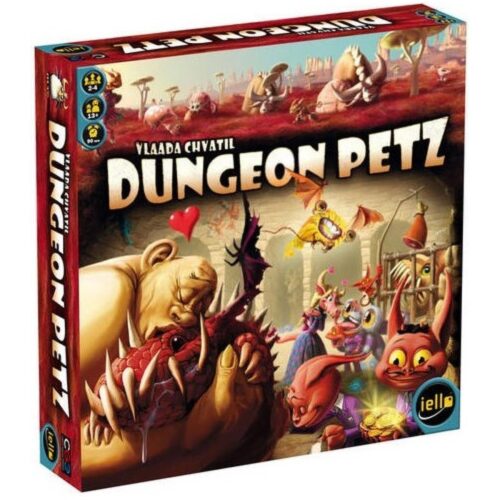 Become the leader of an imp family that has just started a new business ? breeding and selling petz. Sound simple and safe? Well, we forgot to mention that those petz are for Dungeon Lords. This means magical, playful, sometimes angry monsters that constantly desire attention and at the very moment you want them to demonstrate their qualities to buyers they are sick or they poop. Sometimes you are even glad that you got rid of them ? but the profit is unbelievable. Dungeon Petz is a standalone game set in the Dungeon Lords universe. The game consists of several rounds in which players use unusual worker placement mechanisms (players simultaneously prepare different sized groups of imps in order to play sooner than others) to prepare themselves for the uneasy task of raising creature cubs and pleasing their different needs (represented by cards) in order to sell them as grown and scary creatures to Dungeon Lords. In the meantime, they also attend various contests in which they show off their pets, scoring additional points.
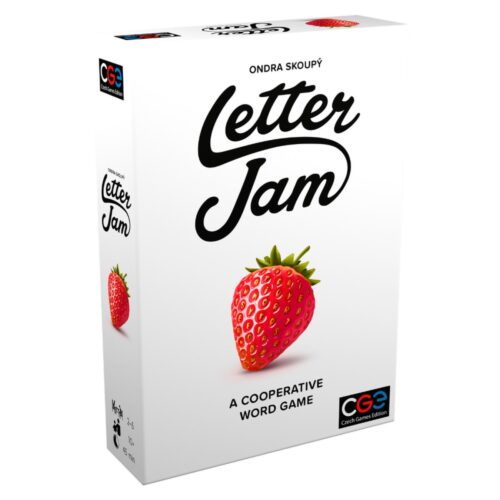 Letter Jam is a 2-6 player cooperative word game where players assist each other in composing meaningful words from letters around the table. The trick is holding the letter card so that it?s only visible to other players and not to you. At the start of the game, each player receives a set of face-down letter cards that can be arranged to form an existing word. The setup can be prepared by using a special card scanning app, or by players selecting words for each other. Each player then puts their first card in their stand facing the other players without looking at it, and the game begins. The game is played in turns. Each turn, players simultaneously search other players? letters to see what words they can spell out (telling the others the length of the word they can make up). The player who offers the longest word can then be chosen as the clue giver. The clue giver spells out their clue by putting numbered tokens in front of the other players. Number one goes to the player whose letter comes first in the clue, number two to the second letter etc. They can always use a wild card which can be any letter, but they cannot tell others which letter it represents. Each player with a numbered token (or tokens) in front of them then tries to figure out what their letter is. If they do, they place the card face down before revealing the next letter. At the end of the game, players can then rearrange the cards to try to form an existing word. All players then reveal their cards to see if they were successful or not. The more players who have an existing word in front of them, the bigger their common success.
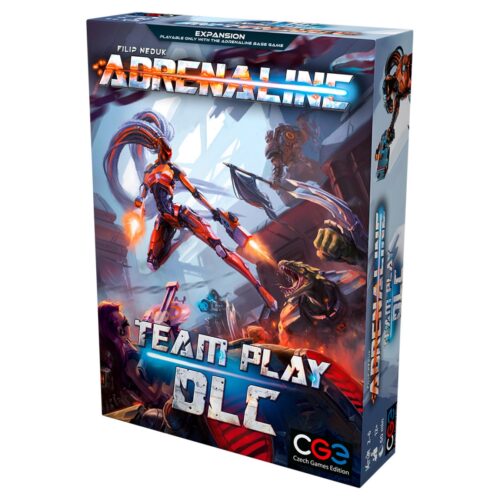 The Adrenaline: Team Play DLC expansion allows you to add a sixth player to the Adrenaline Deathmatch mayhem. It introduces character-specific weapons and abilities bringing new effects and experiences to the game. Take full advantage of your actions with the unique Adrenaline Rush system and boost your epic shot. Streamlined gameplay allows you to focus on what Adrenaline is really about: quickly grabbing ammo and start shooting. Winning conditions are set at the beginning of each game for a bigger variety of how to play and win! A new team mode introduced in this DLC requires effective communication with your team, to combine your abilities, use the position of your opponents to your advantage, and enjoy creating sophisticated strikes!
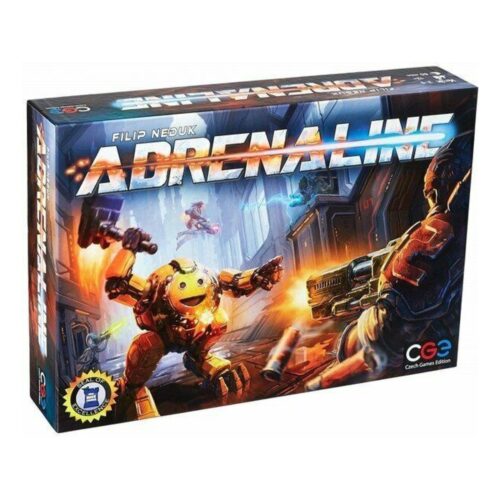 In the future, war has left the world in complete destruction and split the people into factions. The factions have decided to stop the endless war and settle their dispute in the arena. A new virtual bloodsport was created. The Adrenaline tournament. Every faction has a champion, every champion has a chance to fight and the chance to win. Will you take the chance of becoming the next champion of the Adrenaline tournament? Play a first-person shooter on your gaming table. Grab some ammo, grab a gun, and start shooting. Build up an arsenal for a killer turn. Combat resolution is quick and diceless. And if you get shot, you get faster!